Yes, but only if you’re chewing the right kind of gum.
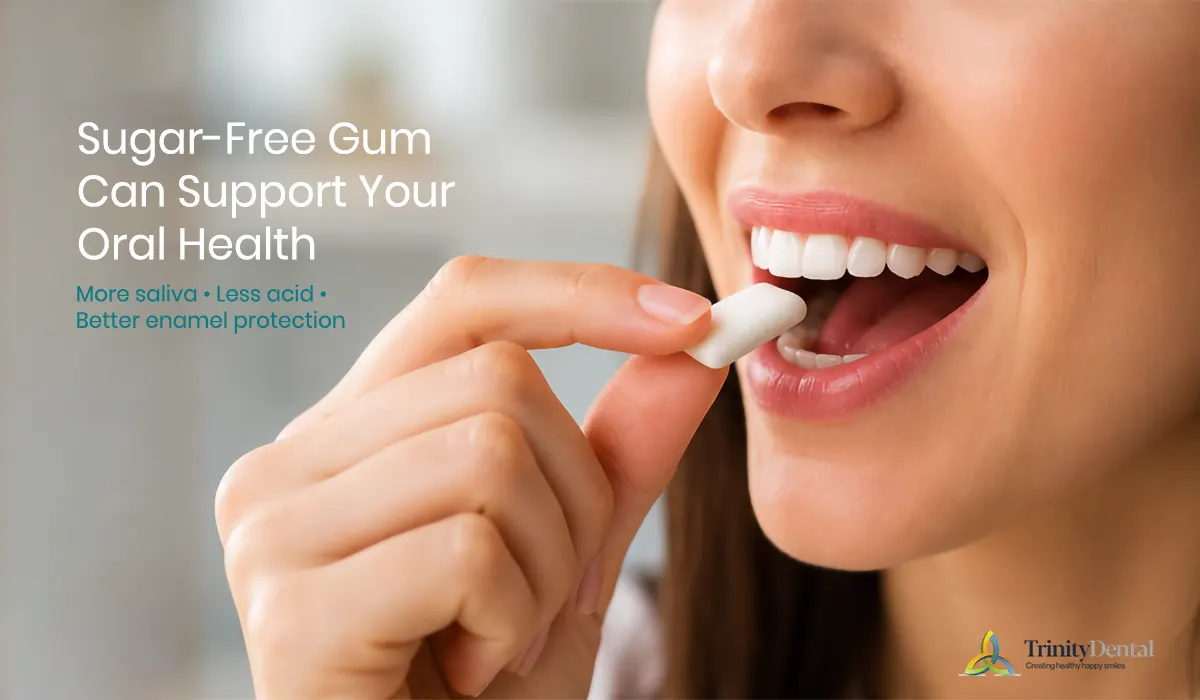
Sugar-free chewing gum, particularly one sweetened with xylitol, can genuinely support your oral health. It encourages saliva production, helps neutralise acids after eating, and makes it more difficult for harmful bacteria to thrive. On the other hand, chewing gum that contains sugar does exactly what your dentist hopes you’ll avoid it feeds the bacteria responsible for tooth decay.
That sounds simple enough, yet it’s only part of the story.
Whether chewing gum is actually healthy for your teeth depends on several things that rarely get discussed together: when you chew it, how long you chew it, the ingredients inside it, your own saliva production, and even how your jaw functions.
Someone who chews sugar-free gum for fifteen minutes after lunch may be helping protect their enamel. Another person who chews the same gum continuously for six hours while working at a computer could end up with jaw pain, headaches, or worsening symptoms of TMJ dysfunction.
So the real answer isn’t simply “yes” or “no.”
It’s “yes when it’s used as a tool rather than a habit.”
Why Your Mouth Actually Benefits from Chewing
Most people think chewing gum helps because it somehow “cleans” the teeth.
It doesn’t.
The real benefit comes from something far more interesting: saliva.
Saliva is one of the most underestimated parts of your body’s natural defence system. Dentists often describe it as your mouth’s own protective rinse because it’s constantly working behind the scenes.
Every time you chew, your brain signals the salivary glands to produce more saliva. That increase triggers several protective processes all at once.
Saliva Helps Neutralise Harmful Acids
Every meal changes the environment inside your mouth.
As bacteria digest carbohydrates and sugars left behind on your teeth, they produce acids. Those acids temporarily lower the pH of your mouth. Once the pH drops below roughly 5.5, enamel begins losing minerals in a process called demineralisation.
This doesn’t mean a cavity forms immediately.
Instead, think of enamel as entering a vulnerable state.
Saliva gradually restores balance by diluting those acids and raising the pH back toward neutral. Once that happens, minerals such as calcium and phosphate can begin repairing the enamel surface.
This natural repair process is happening every day without you noticing it.
Chewing sugar-free gum simply speeds it up.
The American Dental Association (ADA) recognises that chewing sugar-free gum after eating stimulates saliva and can reduce the risk of cavities when used alongside regular brushing and flossing.
Saliva Isn’t Just Water
One reason people underestimate saliva is because it looks like plain water.
It isn’t.
Healthy saliva contains:
- Calcium
- Phosphate
- Proteins
- Enzymes
- Antibacterial compounds
- Buffering agents that control acidity
Together these create an environment where enamel can repair tiny areas of mineral loss before permanent damage occurs.
That’s something many online articles never explain.
Your teeth are constantly moving through small cycles of damage and repair throughout the day.
The goal isn’t to stop those cycles entirely.
The goal is to keep the repair phase winning.
Why Dentists Often Suggest Gum After Meals
Notice that dentists usually recommend chewing gum after eating, not randomly throughout the day.
That’s because the first twenty to thirty minutes after a meal are when your mouth experiences one of its biggest acid challenges.
Imagine finishing:
- Pasta
- Bread
- Fruit
- Rice
- Crisps
- A sandwich
- Coffee with sugar
Even foods people consider “healthy” can provide carbohydrates that oral bacteria convert into acids.
Chewing sugar-free gum for around 10 to 20 minutes after eating gives saliva production a noticeable boost exactly when your mouth needs it most.
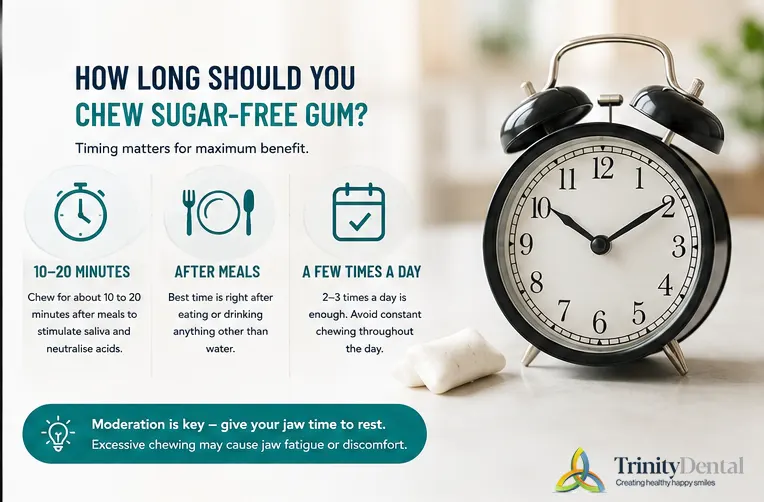
The Oral Health Foundation also recommends sugar-free gum after meals because increased saliva helps neutralise plaque acids and supports enamel protection.
Not All Sugar-Free Gum Is Equal
Walk into any supermarket and you’ll see shelves filled with products labelled “sugar-free.”
Many people assume they’re all equally good.
They’re not.
The sweetener matters.
Some sugar-free gums mainly use:
- Sorbitol
- Mannitol
- Aspartame
- Sucralose
These are generally considered tooth-friendly because oral bacteria cannot easily convert them into acids.
But xylitol stands apart for a different reason.
Instead of simply avoiding harm, it may actively interfere with cavity-causing bacteria.
Why Xylitol Gets So Much Attention
One of the primary bacteria involved in tooth decay is Streptococcus mutans.
This bacterium loves ordinary sugar.
When sugar is available, it rapidly produces acids that weaken enamel.
Xylitol behaves differently.
The bacteria attempt to absorb it, but they can’t efficiently use it as fuel. This appears to reduce their ability to grow and produce acid over time.
Research has suggested that regular exposure to xylitol may reduce the amount of S. mutans in dental plaque, particularly when consumed consistently as part of an overall oral hygiene routine.
That doesn’t make xylitol a miracle ingredient.
It simply means it offers another small advantage beyond saliva stimulation.
Studies published through the National Institutes of Health (NIH) have explored xylitol’s potential role in reducing cavity-causing bacteria, although researchers also note that it should complemen not replace daily brushing with fluoride toothpaste.
How Much Xylitol Actually Matters?
Here’s something that surprises many patients.
A packet may proudly advertise “contains xylitol.”
That doesn’t necessarily mean there’s enough to make a meaningful difference.
Some chewing gums contain only a tiny amount while relying mainly on other sweeteners.
Dentists who specifically recommend xylitol often suggest looking at the ingredient list rather than the front of the packet.
If xylitol appears near the top of the ingredient list, it’s usually present in a much higher amount than if it’s listed near the bottom.
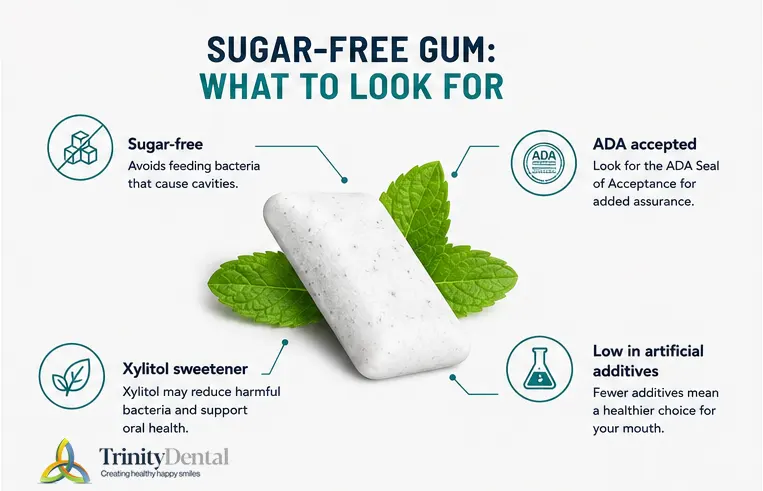
That’s a detail most shoppers never think about.
Sugar-Free Doesn’t Mean Unlimited
It’s easy to assume that because sugar-free gum is “good,” more must be better.
That’s where problems start.
Chewing activates muscles that can generate surprisingly strong forces.
Your jaw joints the temporomandibular joints (TMJs) work thousands of times every day already through talking and eating.
Adding several extra hours of chewing creates additional strain.
Most healthy people won’t notice.
Some absolutely will.
People who grind their teeth at night, clench during stressful days, or already experience jaw clicking may find that constant gum chewing quietly worsens their symptoms over time.
Interestingly, dentists often identify habitual gum chewers before patients mention it themselves.
The clues include:
- Enlarged jaw muscles
- Tenderness near the ears
- Tooth wear from clenching
- Morning headaches
- Muscle fatigue during dental examinations
None of these automatically mean chewing gum is the cause.
But excessive chewing can become another piece of the puzzle.
Is Chewing Gum Better Than Brushing?
Not even close.
This is probably the biggest misunderstanding surrounding chewing gum.
Some people treat it like a substitute for brushing after lunch.
It isn’t.
Think of brushing and chewing gum as doing completely different jobs.
| Oral Care Habit | What It Actually Does |
|---|---|
| Brushing | Removes plaque and food deposits from tooth surfaces |
| Flossing | Cleans between teeth where brushes cannot reach |
| Fluoride toothpaste | Strengthens enamel and helps reverse early mineral loss |
| Sugar-free chewing gum | Stimulates saliva and helps neutralise acids after eating |
That’s why dentists don’t recommend choosing one over the other.
Each serves a different purpose.
If you cannot brush after lunch because you’re at work, travelling, or out for the day, sugar-free gum becomes a helpful temporary measure not a replacement.
In fact, the NHS consistently advises maintaining twice-daily brushing with fluoride toothpaste as the foundation of good oral health, regardless of whether you chew gum.
When Chewing Gum Can Become a Problem
For something that seems harmless, chewing gum can occasionally create problems that have nothing to do with cavities.
Most of these aren’t caused by the gum itself they’re caused by how people use it.
There’s a big difference between chewing a piece of gum for fifteen minutes after lunch and keeping one in your mouth for most of the working day.
Dentists tend to notice that difference quickly.
Your Jaw Wasn’t Designed for Constant Exercise
The muscles that move your jaw are incredibly strong.
In fact, the masseter muscle is one of the strongest muscles in the body relative to its size. Every bite you take recruits several muscles working together with remarkable precision.
When you’re eating, those muscles work for a purpose.
When you’re chewing gum for hours, they’re simply repeating the same movement over and over.
Some people never notice.
Others gradually develop:
- Jaw soreness
- Clicking or popping joints
- Tight facial muscles
- Headaches around the temples
- Ear discomfort that isn’t actually an ear problem
- Difficulty opening the mouth fully
People often assume these symptoms appeared “out of nowhere.”
Sometimes they’re surprised to discover that chewing gum during meetings, driving, studying or working at a computer has become an unconscious habit lasting several hours every day.
Reducing that chewing time alone is sometimes enough to noticeably ease muscle fatigue.
If You Grind or Clench Your Teeth, Be Careful
Many adults clench their teeth without realising it.
Stress is one reason.
Concentration is another.
Some people clench while driving. Others do it while answering emails or lifting heavy objects.
If you already have a habit of clenching or grinding (known as bruxism), excessive gum chewing may add even more workload to muscles that rarely get a chance to relax.
That doesn’t automatically mean you should never chew gum.
It simply means moderation becomes much more important.
A dentist may even advise limiting gum altogether if you have persistent jaw pain or signs of temporomandibular joint (TMJ) dysfunction.
Can Chewing Gum Damage Fillings or Crowns?
Generally, no.
Modern fillings, crowns and dental restorations are designed to cope with normal chewing forces.
However, there are a few exceptions.
Very sticky chewing gum can occasionally pull on:
- Temporary crowns
- Loose fillings
- Older dental restorations
- Poorly bonded veneers
- Certain orthodontic appliances
If a filling comes out while chewing gum, the gum probably wasn’t the real problem.
More often, it exposed an issue that was already developing.
A well-fitted permanent filling shouldn’t simply fall out because someone chewed a piece of sugar-free gum.
What About Braces and Invisalign?
This depends on the type of orthodontic treatment.
Traditional Braces
Most orthodontists recommend avoiding chewing gum with fixed braces.
Sticky gum can:
- Wrap around brackets
- Become trapped under wires
- Increase cleaning difficulty
- Occasionally loosen orthodontic components
Even sugar-free gum can create these problems.
Invisalign Aligners
With clear aligners, the answer is much simpler.
Take the aligners out before chewing gum.
Never chew gum while wearing them.
Gum can stick to the plastic and may affect how the aligners fit against the teeth.
Is Chewing Gum Healthy for Your Teeth if You Have Dry Mouth?
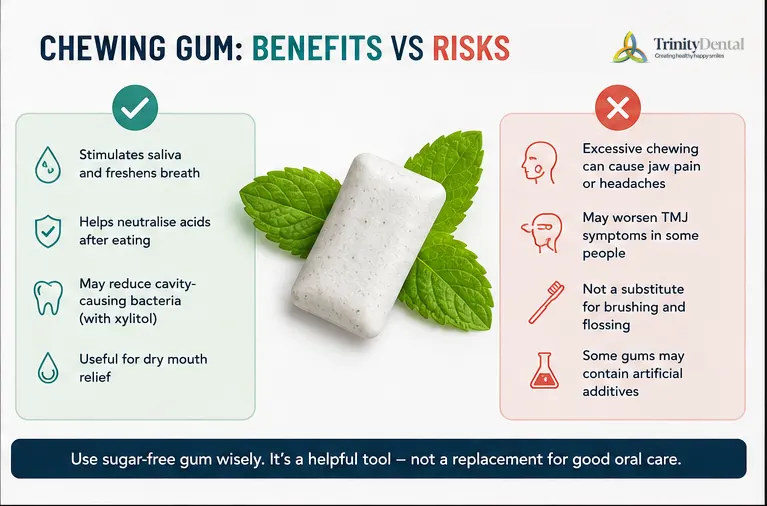
For many people with dry mouth, chewing sugar-free gum isn’t just helpful—it can make everyday life much more comfortable.
Dry mouth (xerostomia) isn’t simply an inconvenience.
Without enough saliva, the mouth loses many of its natural protective functions.
That means higher risks of:
- Tooth decay
- Gum disease
- Bad breath
- Difficulty swallowing
- Mouth infections
- Burning sensations
- Problems wearing dentures comfortably
Common causes include:
- Certain blood pressure medications
- Antidepressants
- Diabetes
- Autoimmune conditions such as Sjögren’s syndrome
- Radiation treatment
- Natural ageing
If the salivary glands still have some function, chewing sugar-free gum may stimulate them to produce more saliva naturally.
The National Institute of Dental and Craniofacial Research (NIDCR) includes sugar-free chewing gum among the strategies that may help people manage dry mouth symptoms.
What Most People Don’t Realise About Saliva
People usually notice saliva only when they don’t have enough of it.
Dentists notice something different.
Patients with healthy saliva often develop surprisingly few cavities even when their brushing habits aren’t perfect.
Meanwhile, people with severe dry mouth can develop multiple cavities within months despite brushing carefully.
That’s because saliva works continuously.
Every minute.
Even while you’re asleep, although production slows dramatically.
It’s one of the reasons dentists become concerned when patients mention constantly needing water to swallow food or waking with an extremely dry mouth.
Common Myths About Chewing Gum
Let’s clear up a few misconceptions.
1: Gum Removes Plaque
No.
Chewing gum may help remove loose food particles, but it does not physically remove plaque the way brushing does.
Plaque is a sticky bacterial biofilm attached to the tooth surface.
Only brushing and flossing can effectively remove it.
2: Sugar-Free Gum Prevents Cavities by Itself
Also no.
Think of sugar-free gum as something that improves the environment inside your mouth.
It supports your teeth.
It doesn’t replace:
- Fluoride toothpaste
- Daily brushing
- Flossing
- Healthy eating
- Regular dental examinations
3: All Sugar-Free Gum Is the Same
As discussed earlier, the sweetener matters.
Most sugar-free gums are better than sugary alternatives.
Those containing higher levels of xylitol may provide additional antibacterial benefits.
4: Swallowing Gum Stays in Your Stomach for Seven Years
This is one of the oldest myths around.
It isn’t true.
Although swallowing gum isn’t recommended, the gum base usually passes through the digestive system much like other indigestible materials.
It doesn’t remain inside the stomach for years.
How Dentists Usually Recommend Using Chewing Gum
If you asked ten experienced dentists for practical advice, you’d probably hear something very similar.
A sensible routine looks like this:
| Habit | Recommendation |
|---|---|
| Type of gum | Sugar-free, preferably with xylitol |
| Best time | After meals or sugary drinks |
| Duration | Around 10–20 minutes |
| Daily use | A few times per day if needed |
| Continuous chewing | Avoid |
| Replacement for brushing? | Never |
Notice that moderation appears repeatedly.
That’s because chewing gum is most useful when it supports your oral hygiene—not when it becomes a habit in its own right.
So, Is Chewing Gum Healthy for Your Teeth?
For most people, yes.
Used correctly, sugar-free chewing gum is one of the simplest ways to encourage your mouth’s natural defence system.
It stimulates saliva exactly when your teeth need it most.
It helps neutralise acids after meals.
It may reduce the activity of cavity-causing bacteria, especially if it contains xylitol.
It can also make life noticeably easier for people who experience dry mouth.
But it has limits.
It won’t remove plaque.
It won’t undo the effects of frequent sugary snacks.
It won’t replace fluoride toothpaste.
And if you’re chewing continuously throughout the day, it may end up irritating your jaw more than helping your teeth.
The healthiest approach is surprisingly straightforward:
Brush twice a day with fluoride toothpaste.
Clean between your teeth every day.
Limit sugary foods and drinks.
Visit your dentist regularly.
And if you enjoy chewing gum, choose a sugar-free variety and keep it to around fifteen or twenty minutes after meals.
That’s where the evidence is strongest and where dentists are most likely to agree.
Frequently Asked Questions
No. Daily use of sugar-free gum is generally considered safe and may even benefit your oral health when chewed for short periods after meals. Problems are more likely to arise from excessive chewing rather than daily use itself.
Not in the way whitening treatments do. Some gums are marketed as whitening products because they help remove a small amount of surface staining through increased saliva and gentle abrasion, but they cannot change the natural colour of your teeth.
If you cannot brush your teeth, chewing sugar-free gum for about 10–20 minutes after meals is a practical alternative. It helps stimulate saliva and neutralise acids until you can brush properly.
In many cases, yes. Xylitol not only avoids feeding cavity-causing bacteria but may also reduce their activity over time, giving it an advantage over some other sugar substitutes.
Yes, provided they are old enough not to swallow it. Sugar-free gum can be a useful addition to a child’s oral care routine, but it should never replace brushing with fluoride toothpaste or regular dental check-ups.
Why Choose Trinity Dental?
We believe good dental advice should fit real life. Every patient has different habits, different concerns, and different goals, so we don’t rely on one-size-fits-all recommendations.
Whether you’re wondering if chewing gum is helping your teeth, struggling with recurring cavities, experiencing jaw discomfort, or simply due for a routine examination, our team takes the time to understand the bigger picture. We look beyond individual symptoms to identify the everyday factors that influence your long-term oral health.
Preventive care is at the heart of what we do. By spotting early signs of enamel wear, gum disease, bite problems, or tooth decay, we can often recommend simpler, less invasive treatments before small issues become larger ones.
If you’d like personalised guidance on keeping your teeth healthy, or it’s time for your next dental check-up, we’d be delighted to help.
Book an appointment with Trinity Dental today and let our experienced team help you maintain a healthy smile for years to come.